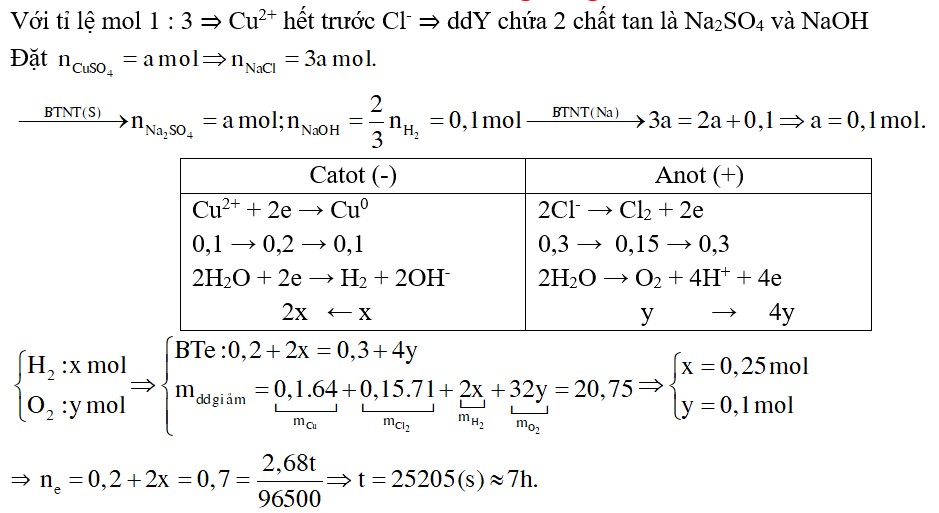
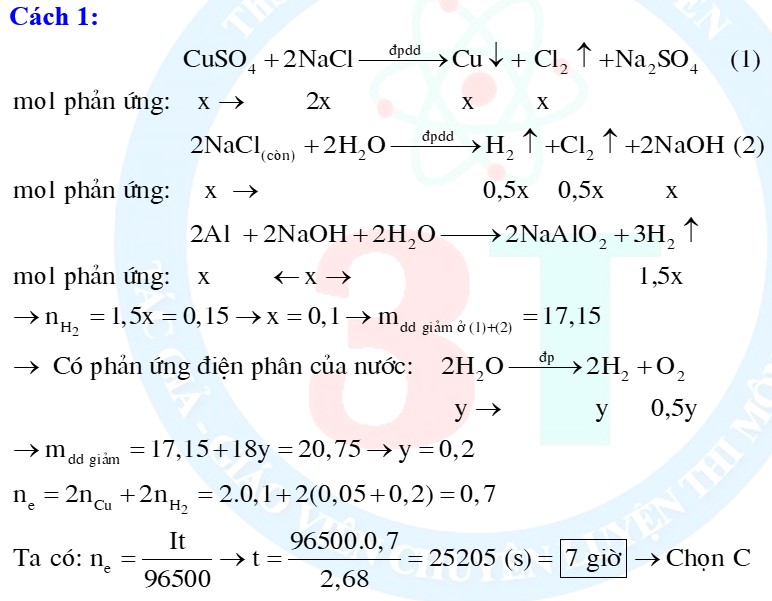
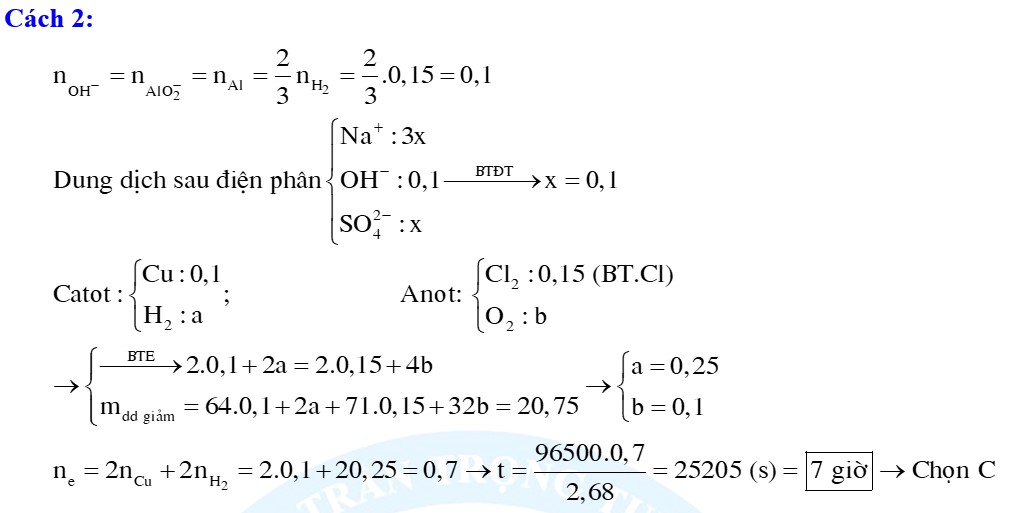
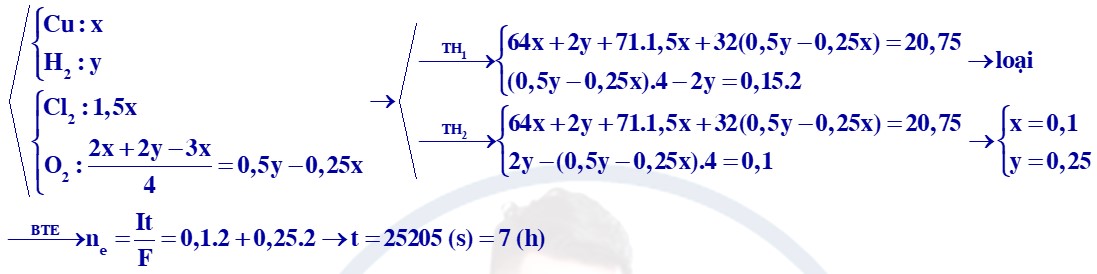
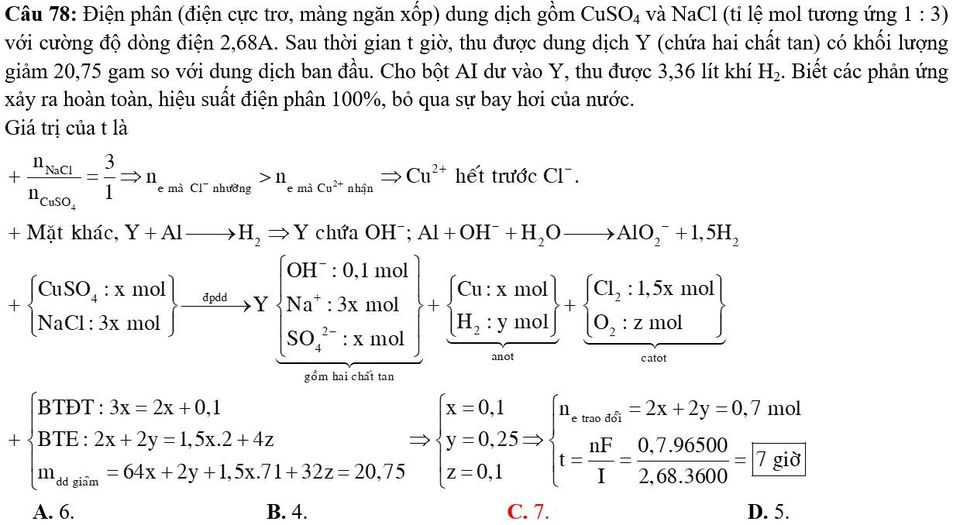
Điện phân (điện cực trơ, màng ngăn xốp) dung dịch gồm CuSO4 và NaCl (tỉ lệ mol tương ứng 1 : 3) với cường độ dòng điện 2,68A
Điện phân (điện cực trơ, màng ngăn xốp) dung dịch gồm CuSO4 và NaCl (tỉ lệ mol tương ứng 1 : 3) với cường độ dòng điện 2,68A. Sau thời gian t giờ, thu được dung dịch Y (chứa hai chất tan) có khối lượng giảm 20,75 gam so với dung dịch ban đầu. Cho bột Al dư vào Y, thu được 3,36 lít khí H2. Biết các phản ứng xảy ra hoàn toàn, hiệu suất điện phân 100%, bỏ qua sự bay hơi của nước. Giá trị của t là
A. 6. B. 4. C.7. D.5.
Cách 1 (thầy Trần Thanh Bình)
Cách 2 (thầy Trần Trọng Tuyền)
Cách 3 (team BTN)
Cách 4 (thầy Nguyễn Minh Tuấn)
Đây là 1 câu trong đề minh họa năm 2022
Mời các thầy cô và các em xem thêm các câu khác trong đề
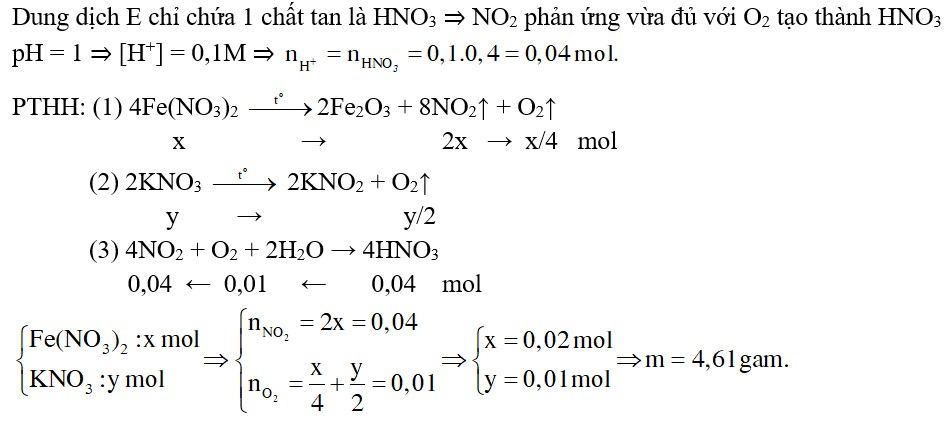
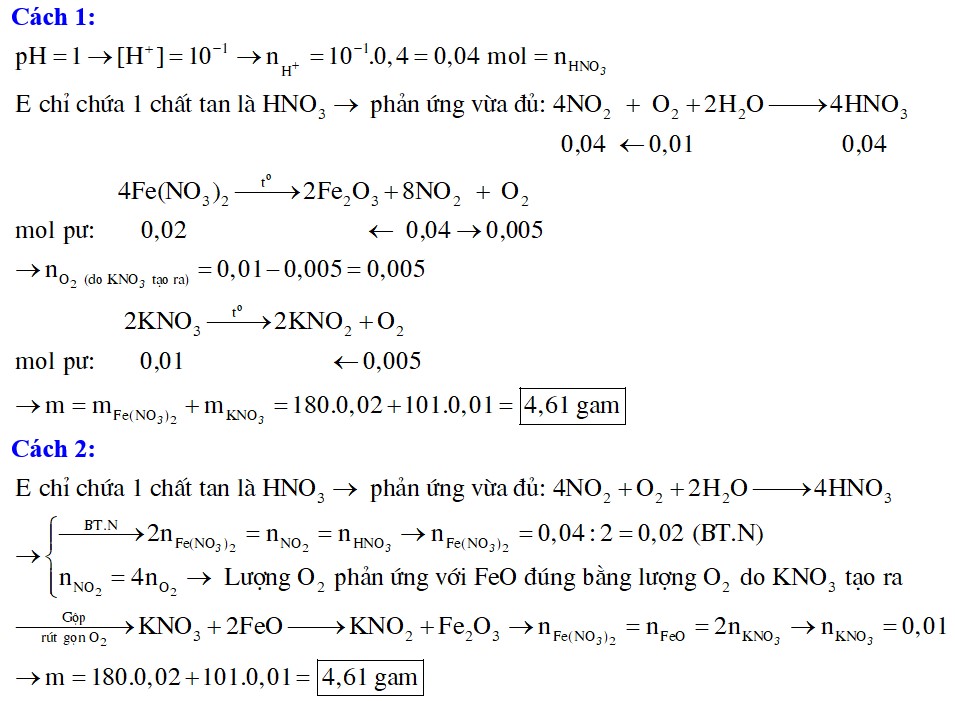
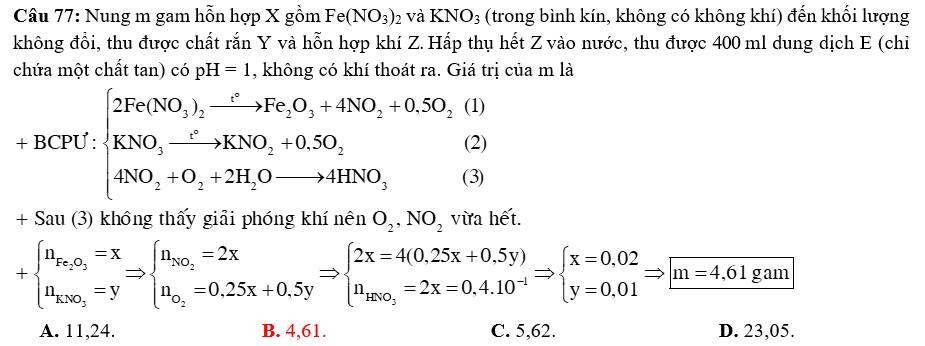
Nung m gam hỗn hợp X gồm Fe(NO3)2 và KNO3 (trong bình kín, không có không khí) đến khối lượng không đổi
Nung m gam hỗn hợp X gồm Fe(NO3)2 và KNO3 (trong bình kín, không có không khí) đến khối lượng không đổi, thu được chất rắn Y và hỗn hợp khí Z. Hấp thụ hết Z vào nước, thu được 400 ml dung dịch E (chỉ chứa một chất tan) có pH = 1, không có khí thoát ra. Giá trị của m là
A. 11,24. B. 4,61.C.5,62. D.23,05.
Cách 1 (thầy Trần Thanh Bình)
Cách 2 (thầy Trần Trọng Tuyền)
Cách 3 (team BTN)
Cách 4 (thầy Nguyễn Minh Tuấn)
Đây là 1 câu trong đề minh họa năm 2022
Mời các thầy cô và các em xem thêm các câu khác trong đề
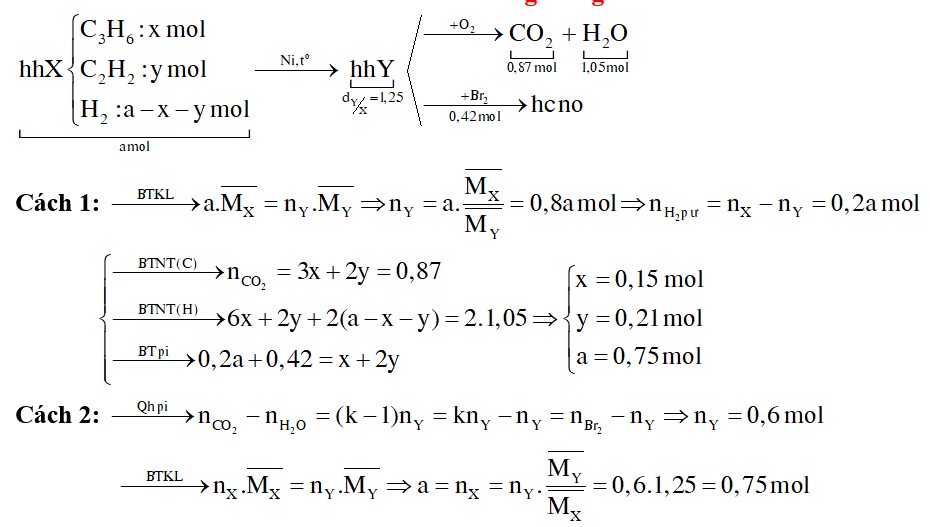
Nung nóng a mol hỗn hợp X gồm propen, axetilen và hiđro với xúc tác Ni trong bình kín (chỉ xảy ra phản ứng cộng H2)
Nung nóng a mol hỗn hợp X gồm propen, axetilen và hiđro với xúc tác Ni trong bình kín (chỉ xảy ra phản ứng cộng H2), sau một thời gian thu được hỗn hợp khí Y có tỉ khối so với X là 1,25. Đốt cháy hết Y, thu được 0,87 mol CO2 và 1,05 mol H2O. Mặt khác, Y phản ứng tối đa với 0,42 mol brom trong dung dịch. Giá trị của a là
A. 0,45. B. 0,60. C.0,30. D. 0,75.
Cách 1 (thầy Trần Thanh Bình)
Cách 2 (thầy Trần Trọng Tuyền)
Cách 3 (team BTN)
Cách 4 (thầy Nguyễn Minh Tuấn)
Đây là 1 câu trong đề minh họa năm 2022
Mời các thầy cô và các em xem thêm các câu khác trong đề
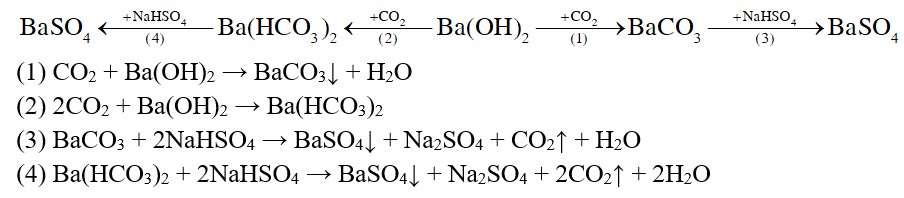
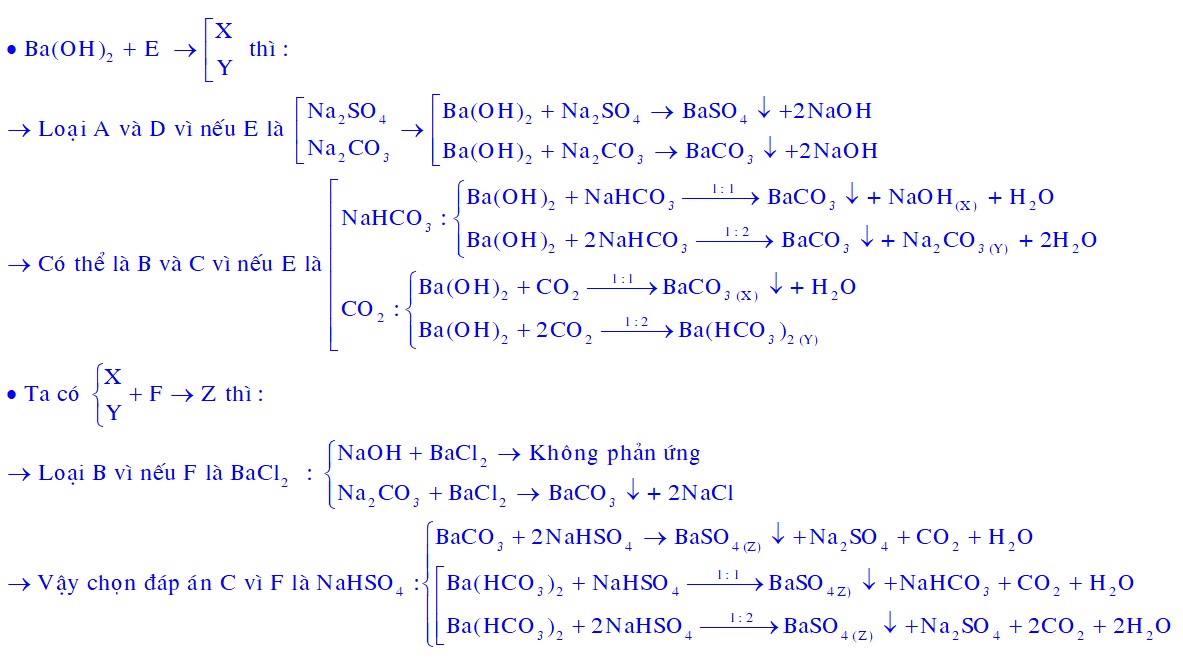
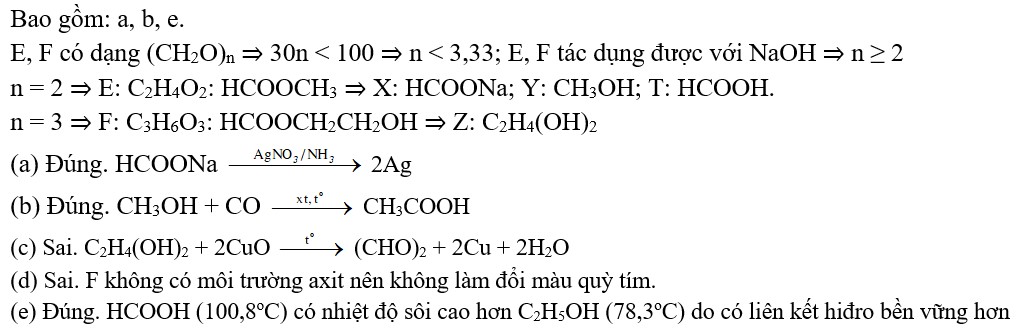
Cho sơ đồ chuyển hóa: Z ← (+F) X ← (+E) Ba(OH)2 (+E)→Y (+F) → Z
Cho sơ đồ chuyển hóa:
Z ← (+F) X ← (+E) Ba(OH)2 (+E)→Y (+F) → Z
Biết: X, Y, Z, E, F là các hợp chất khác nhau, mỗi mũi tên ứng với một phương trình hóa học của phản ứng xảy ra giữa hai chất tương ứng. Các chất E, F thỏa mãn sơ đồ trên lần lượt là
A. Na2SO4, NaOH. B. NaHCO3, BaCl2. C. CO2, NaHSO4.D.Na2CO3, HCl.
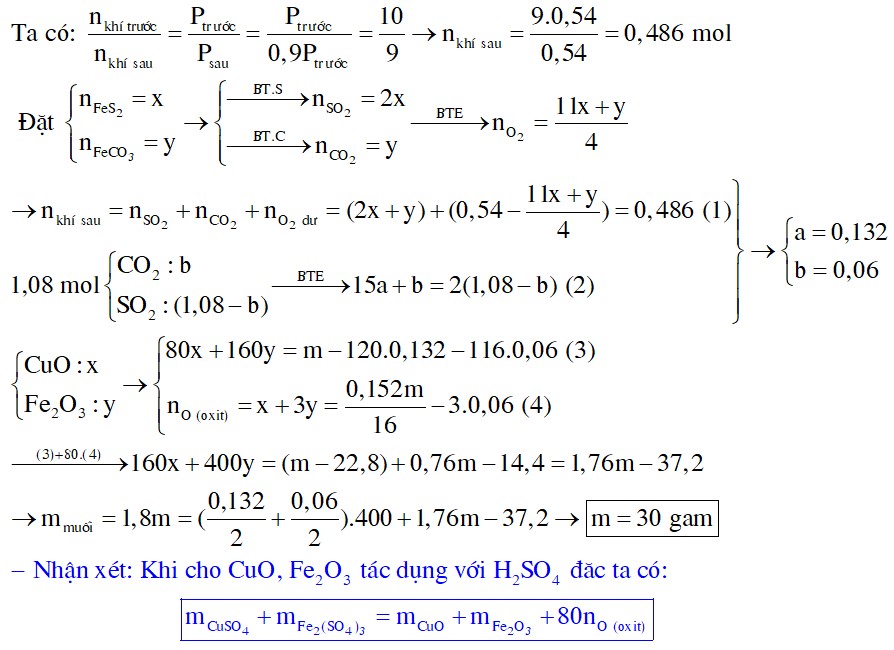
Cho m gam hỗn hợp X gồm FeS2, FeCO3, CuO và Fe2O3 (trong X nguyên tố oxi chiếm 15,2% về khối lượng) vào bình kín
Cho m gam hỗn hợp X gồm FeS2, FeCO3, CuO và Fe2O3 (trong X nguyên tố oxi chiếm 15,2% về khối lượng) vào bình kín (thể tích không đổi) chứa 0,54 mol O2 (dư). Nung nóng bình đến khi các phản ứng xảy ra hoàn toàn rồi đưa về nhiệt độ ban đầu thì áp suất trong bình giảm 10% so với áp suất ban đầu (coi thể tích chất rắn thay đổi không đáng kể). Mặt khác, hòa tan hết m gam X bằng dung dịch H2SO4 đặc nóng, thu được dung dịch Y chứa 1,8m gam hỗn hợp muối (gồm Fe2(SO4)3, CuSO4) và 1,08 mol hỗn hợp khí gồm CO2, SO2. Giá trị của m là
A. 20. B. 25. C.15. D. 30.
Cách 1 (thầy Trần Thanh Bình)
Cách 2 (thầy Trần Trọng Tuyền)
Cách 3 (team BTN)
Cách 4 (thầy Nguyễn Minh Tuấn)
Đây là 1 câu trong đề minh họa năm 2022
Mời các thầy cô và các em xem thêm các câu khác trong đề
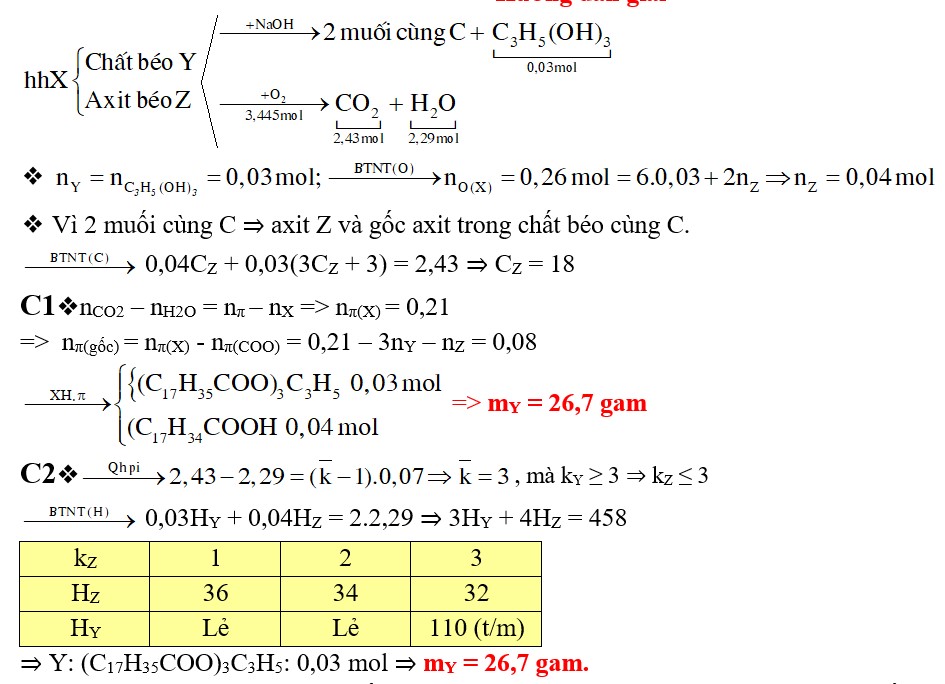
Hỗn hợp X gồm triglixerit Y và axit béo Z. Cho m gam X phản ứng hoàn toàn với dung dịch NaOH dư, thu được sản phẩm hữu cơ
Hỗn hợp X gồm triglixerit Y và axit béo Z. Cho m gam X phản ứng hoàn toàn với dung dịch NaOH dư, thu được sản phẩm hữu cơ gồm hai muối có cùng số nguyên tử cacbon và 2,76 gam glixerol. Nếu đốt cháy hết m gam X thì cần vừa đủ 3,445 mol O2, thu được 2,43 mol CO2 và 2,29 mol H2O. Khối lượng của Y trong m gam X là
A. 26,34 gam. B. 26,70 gam.C.26,52 gam. D.24,90 gam.
Cách 1 (thầy Trần Thanh Bình)
Cách 2 (thầy Trần Trọng Tuyền)
Cách 3 (team BTN)
Cách 4 (thầy Nguyễn Minh Tuấn)
Đây là 1 câu trong đề minh họa năm 2022
Mời các thầy cô và các em xem thêm các câu khác trong đề
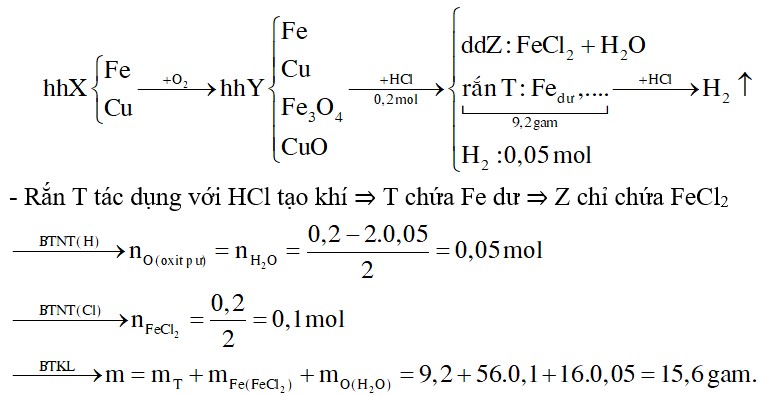
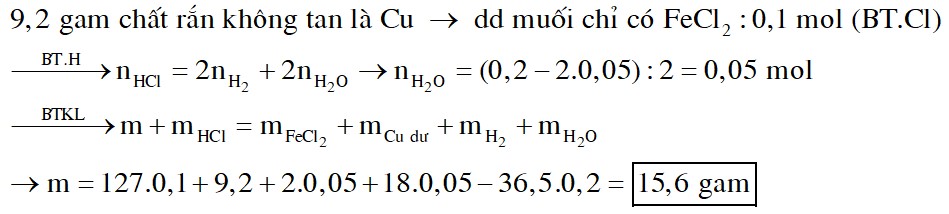
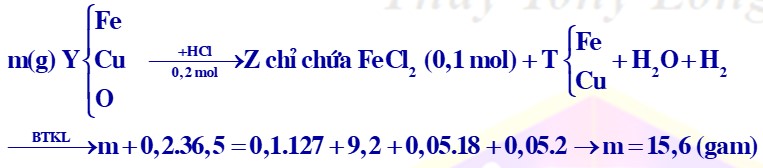
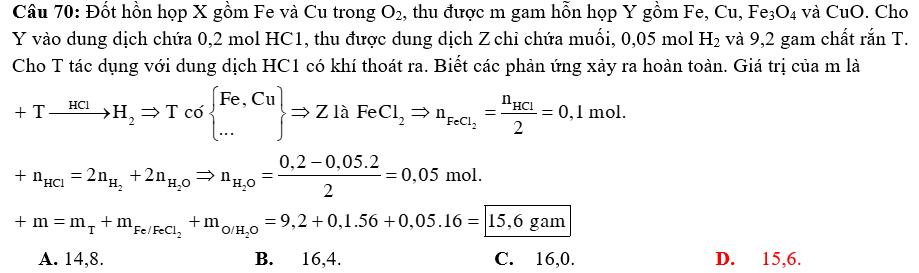
Đốt hỗn hợp X gồm Fe và Cu trong O2, thu được m gam hỗn hợp Y gồm Fe, Cu, Fe3O4 và CuO. Cho Y vào dung dịch chứa
Đốt hỗn hợp X gồm Fe và Cu trong O2, thu được m gam hỗn hợp Y gồm Fe, Cu, Fe3O4 và CuO. Cho Y vào dung dịch chứa 0,2 mol HCl, thu được dung dịch Z chỉ chứa muối, 0,05 mol H2 và 9,2 gam chất rắn T. Cho T tác dụng với dung dịch HCl có khí thoát ra. Biết các phản ứng xảy ra hoàn toàn. Giá trị của m là
A. 14,8. B. 16,4. C.16,0. D. 15,6.
Cách 1 (thầy Trần Thanh Bình)
Cách 2 (thầy Trần Trọng Tuyền)
Cách 3 (team BTN)
Cách 4 (thầy Nguyễn Minh Tuấn)
Đây là 1 câu trong đề minh họa năm 2022
Mời các thầy cô và các em xem thêm các câu khác trong đề
Mark A, B, C, or D on your answer sheet to indicate the correct answer to each of the following questions.
Question 1: We are _____ to hear that you are leaving. A. sadly B. sad C. sadden D. sadness
Question 2: Your room is comfortable,______? A. does it B. was it c. wasn’t it D. isn’t it
Question 3: Don’t worry, class. Solving this maths problem is by no means a______order. A.deep B. high C. large D. tall
Question 4: She wrote her first cookery book ___________2017. A. at B. in c. with D. on
Question 5: He got a ________ because he drove through the red light. A. fee B. fare C. wage D. fine
Question 6: Nga and Kate are close friends______ they have many things in common. A. despite B. because of C. because D. although
Question 7: Linh liked the_______cat in the pet shop. A. cute grey English B. cute English grey C. grey English cute D. English grey cute
Question 8: The picnic has been_________until next week due to bad weather. A. got out B. put out C. got off D. put off
Question 9: Quyen_________in the supermarket when she saw her old friend. A. was shopping B. shops C. is shopping D. has shopped
Question 10: ___________, I will give you a call. A. When I had arrived in Ha Noi B. When I arrived in Ha Noi C. When I arrive in Ha Noi D. When I was arriving in Ha Noi
Question 11: Jack usually_________fishing with his friends at weekends. A. goes B. makes C. puts D.does
Question 12: Katherine took a deep breath, managing to__________herself before entering the interview room. A. comprise B. consist C. compose D. include
Question 13: The house__________yesterday. A. paints B. was painted C. was painting D. has painted
Question 14: _________a number of novels, she turned to composing music. A. Have written B. Having written C. Have been writing D. Have been written
Question 15: The better its services are,________crowded the restaurant gets. A. most B. most of C. the more D. more
Mark the letter A, B, c, or D on your answer sheet to indicate the sentence that best completes eachof the following exchanges.
Question 16: Peter is asking to borrow Nam’s pen. – Peter: “Can I borrow your pen, Nam?” – Nam: “__________________” A. Me too. B. Here you are. C. Thanks a lot. D. Congratulations!
Question 17: Hai is thanking Tom for his compliment. – Hai: “Thank you for your kind words, Tom.” – Tom: “_________________” A. Same to you. B. Good idea. c. That’s not good. D. You’re welcome.
Mark the letter A, B, C, or D on your answer sheet to indicate the word that differs from the otherthree in the position of stress in each of the following questions.
Question 18: A. colourful B. romantic c. difficult D. positive
Question 19: A. amount B. story c. money D. picture
Mark the letter A, B, c, or D on your answer sheet to indicate the word whose underlined part differs from the other three in pronunciation in each of the following questions.
Question 20: A. stopped B. handed c. worked D. missed Question 21: A. date B. bank c. place D. make
Mark the letter A, B, c, or D on your answer sheet to indicate the word CLOSEST in meaning to the underlined word in each of the following questions.
Question 22: I’m really glad to tell you that you have been selected for the job. A. happy B. lazy c. safe D. quick
Question 23: By taking part-time jobs, students can understand how hard it is to earn a living. A. improve B. raise c. know D. change
Mark the letter A, B, c, or D on your answer sheet to indicate the word(s) OPPOSITE in meaning to the underlined word(s) in each of the following questions.
Question 24: John and Lien are two of a kind – both perfectionists! A. differ from each other B. lead healthy lifestyles c. overcome cultural differences D. share common values
Question 25: There’s never a dull moment when Binh’s around; his funny stories always give people a great time. A. tiring B. interesting c. boring D. disappointing
Mark the letter A, B, c, or D on your answer sheet to indicate the sentence that best combines each pair of sentences in the following questions.
Question 26: Students are forbidden to bring electronic devices into the exam room. There is no exception whatsoever. A. Under no circumstances are students allowed to bring electronic devices into the exam room. B. By no means were students allowed to bring electronic devices into the exam room. c. At no time are students banned from bringing electronic devices into the exam room. D. On no occasion are students banned from bringing electronic devices into the exam room.
Question 27: Jane really wants to buy a new computer. She doesn’t have enough money. A. Provided that Jane has enough money, she can’t buy a new computer. B. If only Jane had had enough money, she couldn’t have bought a new computer. c. If Jane had had enough money, she couldn’t have bought a new computer. D. Jane wishes she had enough money so that she could buy a new computer.
Mark the letter A, B, c, or D on your answer sheet to indicate the underlined part that needs correction in each of the following questions.
Question 28: My brother helps me with my homework yesterday evening. A. helps B. with C. homework D. evening
Question 29: Many teenagers are different from adults in his beliefs about love and marriage. A. teenagers B. different C. hhàm số
D. marriage
Question 30: A comparative house in the city centre would be approximately five times as expensive as this one; you just can’t afford it. A. comparative
B. approximately C. expensive D. afford
Mark the letter A, B, c, or D on your answer sheet to indicate the sentence that is closest in meaningto each of the following questions.
Question 31: It is not necessary for you to do this project. A. You would do this project. B. You can’t do this project. c. You must do this project. D. You needn’t do this project.
Question 32: “I can do this exercise,” Mark said. A. Mark said that I could do that exercise. B. Mark said that he can’t do that exercise. c. Mark said that I can’t do that exercise. D. Mark said that he could do that exercise.
Question 33: He last went out with his friends a month ago. A. He didn’t go out with his friends a month ago. B. He has gone out with his friends for a month. c. He has a month to go out with his friends. D. He hasn’t gone out with his friends for a month.
Read the following passage and mark the letter A, B, c, or D on your answer sheet to indicate thecorrect word or phrase that best fits each of the numbered blanks from 34 to 38.
Television is still one of our most popular forms of entertainment. It brings people closer. (34)__________ families still watch shows or enjoy live sports programmes together. Television gives peoplesomething to talk about at school and at work and it often gets US talking about important issues. (35)___________, television – like everything else in the world today – is changing. The most important (36)__________ on television recently has been technology. Computers and theInternet have completely changed the way we get information and entertainment. Watching films andvideos online is becoming more and more popular. Computers and smartphones, (37)___________ are muchcheaper than ever before, help people choose their favourite programmes quickly and more effectively.Today, as life is getting faster, our mobile screens are the best way to watch programmes anywhere welike. Therefore, television stations have to change the way they make shows in order to give (38)____________ what they want.
(Adapted from Gateway by Spencer and Edwards)
Question 34: A. Every B. Much c. Each D. Many
Question 35: A. Although B. Otherwise c. However D. For example
Question 36: A. ability B. influence c. advantage D. strength
Question 37: A. where B. which c. who D. when
Question 38: A. presenters B. visitors c. viewers D. spectators
Read the following passage and mark the letter A, B, c, or D on your answer sheet to Indicate thecorrect answer to each of the questions from 39 to 43.
Today we hear more and more about the importance of getting enough sleep. Sleep can giveenergy to both our bodies and our brains. It can also affect our feelings, behaviour, and memory. Studies have shown that people in some countries spend less time sleeping and more time working.But our bodies cannot work well without enough sleep. Losing just one or two hours of sleep a night,over a long period of time, can badly affect our health. We cannot work for many hours; we can getangry easily; and we can even lose our IQ points. That explains why, without enough sleep, an intelligent person may have difficulty doing daily tasks. Studies have also shown that the time of year seems to affect how much sleep we need. Peopleusually sleep longer in the winter, sometimes as much as 14 hours a night. However, in the summer, they sometimes sleep as little as six hours, without having any problems.
(Adapted from Strategic Reading by Richards and Eckstut-Didier)
Question 39: What is the passage mainly about? A. Benefits of getting up early B. Ways to sleep better c. Causes of losing sleep D. The importance of sleep
Question 40: Which of the following is NOT mentioned in paragraph 1 as something that can beaffected by sleep? A. memory B. feelings c. behaviour
Question 41: According to paragraph 2, which of the following can be a consequence of losing sleep? A. Our health becomes worse. B. People have less time to work. c. People can finish their daily tasks. D. Our bodies can work better.
Question 42: The word intelligent in paragraph 2 is closest in meaning to. A. clever B. ugly c. careful D. angry
Question 43: The word they in paragraph 3 refers to. A. hours B. people c. problems D. studies
Read the following passage and mark the letter A, B, c, or D on your answer sheet to indicate thecorrect answer to each of the questions from 44 to 50.
As the Internet has become more and more popular, we may be reading a great deal more than weused to. However, the way we are reading materials on the Internet, or online reading, is very differentfrom the way we traditionally read printed materials. In the traditional way of reading, we would start at the beginning of a book and read through to theend. In online reading, in contrast, we start reading a page, but may never finish it because a link onthat page leads us to a passage on a different page, and so on. As we go from one page to another, wehave to remember lots of different ideas at the same time. This new way of reading is quite differentfrom the traditional one. There are both advantages and disadvantages of online reading. In online reading, the brain getsbetter than ever at doing many tasks at the same time, or multitasking; and thanks to this, we can workquickly and think creatively. Multitasking is useful in certain working environments, but it also makesit more difficult for us to read at a deep level. We are, therefore, much less likely to analyse what weread in a critical way, or gain any real insight into the contents we are reading. This might lead to afuture when a whole new generation lacks the ability to think critically and deeply about what they arereading. The world is changing and our brains are probably changing to meet new demands in the modernworld, just as they have always done throughout history. However, it is important for US to considerhow to maintain our critical, deeper reading skills, while still dealing with online reading materials.
(Adapted from Insight by Roberts and Sayer)
Question 44: Which of the following is the best title for the passage? A. More Reading, Less Analysis? B. Is Technology Changing Writing? c. Less Reading, More Problems? D. Is Reading Changing Technology?
Question 45: According to paragraph 2, as we read a page online, we___________. A. may not finish reading the whole page B. always read from the beginning till the end c. never read the first part of the page D. tend to read the last part before anything else
Question 46: The word tasks in paragraph 3 is closest in meaning to. A. interviews B. exams c.jobs D. talks
Question 47: The word it in paragraph 3 refers to. A. what we read B. online reading c. multitasking D. the brain
Question 48: The word insight in paragraph 3 is closest in meaning to. A. status B. understanding c. respect D. attitude
Question 49: Which of the following is NOT true according to the passage? A. We read online materials in the same way as we read printed materials. B. Possibly our brains are changing to meet new demands in the modern world. c. Multitasking enables US to work quickly and think creatively. D. In the traditional way of reading, we would read from the beginning through to the end.
Question 50: Which of the following can be inferred from the passage? A. The brain does not play an important role in the traditional way of reading. B. The traditional way of reading allows people to read at a deep level. c. We used to read much more in the past than we do now. D. Online reading maintains critical and deeper reading skills.